
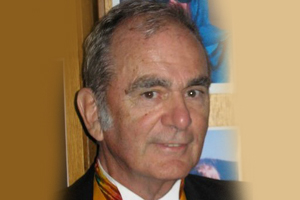
Vale Dafydd Geraint Paul Richards
Founder, Chairman and driving force of The Engineering Link Group
It is with enormous sadness that The Engineering Link Group shares the news of the passing of our founder and Chairman, Paul Richards.
For those of us who knew Paul, it is difficult to separate the man from TELG. Paul was not simply its Chairman. He was its inspiration, its driving force and, for more than three decades, one of the people most determined to help young Australians understand the possibilities that science, mathematics and engineering could open for them.
His legacy can be found in an organisation, and an idea, that began very modestly in Townsville in 1994.
From two teachers in Townsville to something much bigger
The Engineering Link Group began in 1994, when Paul Richards and Greg Millican, two high-school teachers, set out to forge stronger links between schools and the engineering profession. Its first incarnation was a three-day camp for Year 11 students on Magnetic Island, off the coast of Townsville.
The underlying idea was straightforward but powerful: students should not simply be told that mathematics and science are useful. They should experience why they are useful.
They should meet engineers.
They should work on genuine problems.
They should design, calculate, test, fail, rethink and try again.
Above all, they should have the opportunity to be engineers, rather than simply watch engineers.
That philosophy became central to TELG. Its goals included encouraging senior students to study science and mathematics, encouraging more young people to take up engineering as a career, and improving the quality of mathematics and science teaching in Australian schools.
What followed went far beyond that first Townsville program.
Forging links between schools and industry
The phrase that has appeared alongside TELG’s name for so many years, ‘Forging Links between Schools and Industry,’ was never merely a tagline.
It describes much of what Paul spent decades doing.
TELG created opportunities for secondary students and their teachers to work directly with professional engineers, scientists, universities and industry.
Its flagship Engineering Link Project (ELP) dates from 1994 and brought senior secondary STEM students together with engineers and scientists to tackle substantial, real-world engineering problems requiring them to apply mathematics and science.
For students, the objective was not simply to hear somebody talk about engineering as a possible career. They experienced something of what engineers actually do: applying knowledge, collaborating with others and using mathematics and science to solve genuine problems.
And the idea kept growing. The ELP expanded ran it’s first program in Brisbane in 1999, and then in Rockhampton in 2001, Sydney in 2010 and Melbourne in 2011. Since then, there have been ELPs in Sydney, Melbourne, Bendigo, Lismore, Orange, Ballarat, Bathurst, Penrith, Mackay, Bundaberg and Cairns.
Much more than one program
As TELG developed, Paul and Greg looked for different ways of connecting students, teachers and engineers.
TELG recognised, for example, that engineering does not exist in isolation from business, leadership and entrepreneurship.
The Enterprise Management Project (EMP), established in 2004, was developed for Year 12 students interested in engineering, science, business and technological studies. It extended TELG’s work beyond purely technical problem-solving and gave students an opportunity to develop skills in the business and entrepreneurial dimensions surrounding engineering and technology.
TELG also recognised that changing students’ perceptions of mathematics, science and engineering meant working with the people who taught those students every day.
Linking Engineers and Scientists with Teachers (LEaST), established in 2005, connected STEM teachers with engineers and scientists. These workshops demonstrated context-based teaching, broadened teachers’ knowledge and experience of engineering, and shared practical ideas that could be taken back into the classroom.
Regional Engineering Projects extended those opportunities beyond metropolitan centres, with programs connected to local engineering industries and opportunities for students. That commitment continues through TELG’s regional Engineering Link Projects, connecting industry, universities, schools and communities through authentic engineering experiences.
TELG also developed integrated educational resources for Physics, Chemistry, Engineering Studies and Mathematics, connecting engineering principles with higher-order thinking, industry links, authentic pedagogy and real-world research.
The Queensland Bridge Competition (formerly the Spaghetti Bridge Competition) has been in TELG’s suite of student opportunities since Theiss gifted it to us in 2014. Thousands of students in Queensland and New South Wales have glued spaghetti together and tested their skills.
Taking the experience beyond Australia
Paul’s vision for what TELG students could experience was not constrained by state, or even national, borders.
TELG students travelled to England to work with the Smallpeice Trust, extending their experience of engineering into an international setting. Over 40 students from across Queensland travelled to the UK over an 10-year period, from 1999 to 2009, experiencing life and engineering in a very different setting.
TELG later developed China Railway Engineering, established in 2010. Students who had attended an ELP or regional program could apply to attend a workshop at East China Jiao Tong University in Nanchang, where they undertook a railway engineering course jointly developed by TELG and the university while also experiencing Chinese culture and hospitality. Over 150 students were fortunate to experience that unique opportunity.
These opportunities reflected something fundamental about Paul’s view of education.
A student’s understanding of engineering should not be bounded by the walls of a classroom.
If there was an opportunity for students to meet engineers, tackle authentic problems, encounter universities and industry, or see engineering from an entirely different perspective, TELG sought to open that door.
Together, ELP, EMP, LEaST, TELG’s regional projects, the Smallpeice Trust experience in England, China Railway Engineering and its curriculum initiatives demonstrate just how ambitious the original vision became.
TELG was never simply about persuading students to enrol in engineering. It was about connecting what young people learned at school with the much bigger world beyond school and helping them recognise the possibilities available to them.
An impact measured in people, not simply programs
The achievements and programs tell one part of Paul’s story.
But his contribution cannot really be captured by a list of projects or participation figures.
It is in the student who arrived at an Engineering Link Project unsure what an engineer actually did and left wondering whether engineering might be for them.
It is in the students who explored the wider world of technology, enterprise and entrepreneurship through EMP.
It is in the students who travelled to England or China and discovered that the mathematics and science they learned at school could connect them with a profession and a world far beyond their own classroom.
It is in the teacher who could answer a student’s question, ‘When are we ever going to use this?’, with a real engineering application and the experience of having worked alongside engineers themselves.
It is in the relationships built between schools, universities, government, industry and the engineering profession.
And it is in the engineers who gave their time to work with young people, share their profession and help another generation understand the contribution engineering makes to our society.
Bringing those groups together was at the heart of TELG.
A legacy that continues
Perhaps the most fitting measure of Paul’s contribution is that the work continues.
More than three decades after that first project, TELG is still putting students together with engineers and asking them to solve problems.
In 2026 alone, TELG’s Engineering Link Project and Queensland Bridge Competition reached 759 direct student participants across 117 school representations. ELP involved 45 professional and undergraduate engineers, while 158 bridges were tested through the Queensland Bridge Competition.
Our Engineering Link Projects continue to give students direct access to professional engineers, university facilities and real-world engineering problem-solving through partnerships with QUT, CQUniversity, Engineers Australia and the Queensland Government.
Our industry-based programs continue that same philosophy by bringing secondary students and teachers together with engineering professionals and graduates, helping young people better understand engineering study and careers.
The technologies have changed.
The engineering challenges have changed.
But the central idea has endured:
Give young people the chance to experience engineering, not simply hear about it.
That is Paul’s legacy.
Thank you, Paul
Those of us at TELG mourn the loss of our Chairman, colleague and friend.
But we also celebrate what Paul helped create and what he gave to education and engineering.
Paul understood something important long before STEM became the familiar term that it is today: young people are far more likely to value mathematics and science when they can see what those subjects allow people to do.
He spent decades creating opportunities for them to discover exactly that.
Every student who has puzzled over an Engineering Link problem, developed an idea through EMP, built and tested a bridge, travelled overseas through a TELG opportunity or encountered an engineer who opened their eyes to a possible future forms part of that legacy.
So does every teacher who has returned to their classroom with a new idea or a better answer to the perennial question of why mathematics and science matter.
And so does every engineer who has sat beside a student, shared something of their profession and helped another young person imagine themselves following the same path.
What began with two teachers and an idea in Townsville in 1994 became something much larger.
The programs matter.
The partnerships matter.
The achievements matter.
But ultimately, the people whose lives and choices were influenced by those opportunities are Paul’s greatest legacy.
More than three decades after that first project, The Engineering Link Group continues to forge links between schools and industry.
We will continue that work.
Thank you, Paul, for the idea.
Thank you for your vision and your determination to make it happen.
Thank you for the opportunities you created for students and teachers, and for the bridges you built between education and the engineering profession.
We will miss you enormously.
Your legacy lives on.
Comments are closed.